You find a keyword with a KD of 22. Feels like free money. You write a solid piece, throw a few links at it, and wait. Three months later it’s parked on page four, collecting nothing.
Meanwhile the guy in the next Slack channel ranked for a “KD 61” term in eight weeks.
I’ve watched this exact scenario play out more times than I can count, and it almost never comes down to content quality. It comes down to one thing: treating a keyword difficulty score like a verdict instead of what it actually is — a rough guess built on somebody else’s data.
Here’s how KD really works, where it quietly fails you, and the manual audit I run before any keyword earns a spot on the calendar.
What Keyword Difficulty Actually Represents
Keyword Difficulty is a third-party number. A 0–100 score that SEO software spits out to estimate how hard it would be to land on Google’s first page for a query.
Two words in that sentence do all the heavy lifting: third-party and estimate.
Google has never published a ranking difficulty index. There is no “keyword difficulty” field sitting inside Search Console or Google Ads. When you open Ahrefs, Semrush, or Moz, you’re looking at each company’s own algorithm making an educated guess based on who currently ranks.
Which means the score is a snapshot of today’s SERP, not a forecast of what your specific site will need to crack it.
A KD of 45 for a site with deep topical coverage and a clean link profile? Reasonable stretch goal. The same 45 for a six-month-old domain in that niche? That’s not a target, that’s a budget bonfire.
Think of it like a weather forecast for a city you don’t live in. Useful context. Terrible basis for deciding what to wear.
How Top SEO Tools Calculate KD (And Why They Disagree)
Every tool builds its score from a different recipe. Same SERP, three different answers. Once you see what’s under the hood, the chaos makes sense.
Ahrefs Keyword Difficulty
Ahrefs leans almost entirely on referring domain counts. It takes the median number of unique referring domains pointing at the top 10 pages, then maps that onto a 0–100 scale.
Credit where it’s due — Ahrefs actually publishes the formula. A KD of 30 roughly equals 44 referring domains at the median. A KD of 70 demands somewhere around 756.
Where it shines: queries where links genuinely decide the winner.
Where it falls flat: it can’t see content depth, brand strength, or the SERP features quietly eating clicks above the organic results.
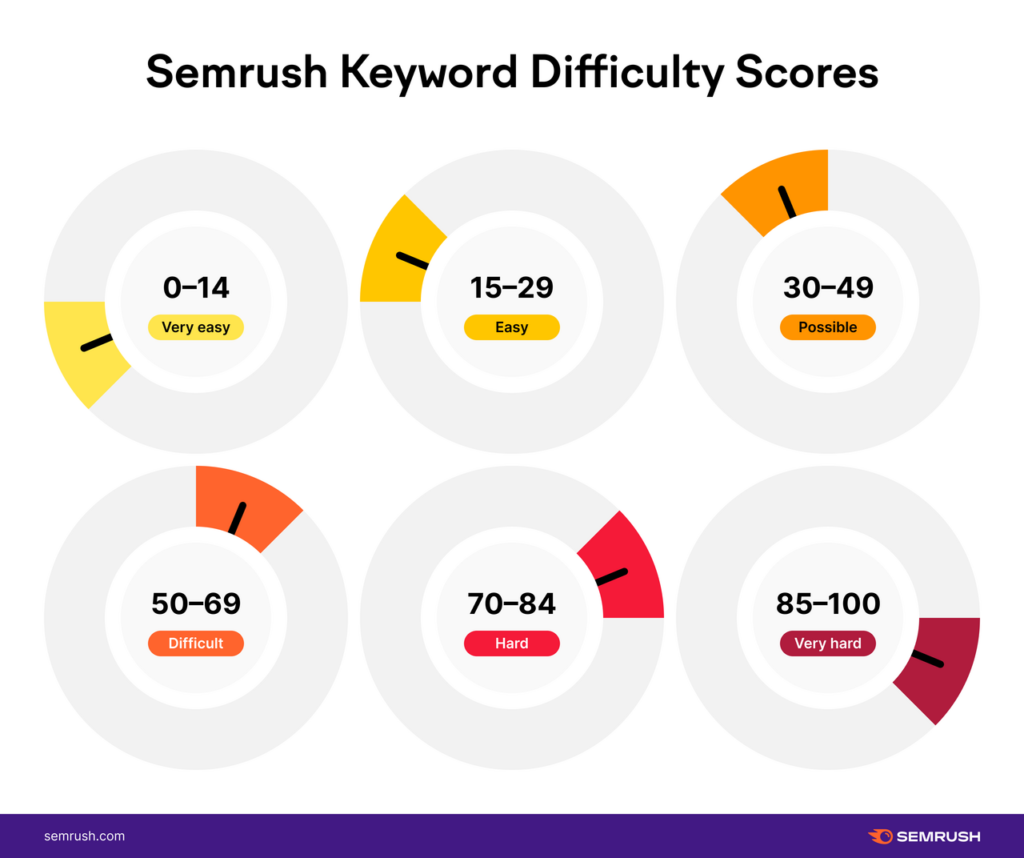
Semrush Keyword Difficulty
Semrush runs a weighted composite model. Links matter, but so do the domain authority of ranking pages, estimated CTR, SERP feature presence (featured snippets, AI Overviews, local packs, shopping units), and intent alignment.
Practical outcome: Semrush tends to score higher than Ahrefs on feature-heavy SERPs. That’s deliberate — it’s pricing in the reality that even a #3 organic spot might pull almost no traffic.
Moz Keyword Difficulty
Moz anchors its score on Page Authority and Domain Authority of the page-one results, then averages them out.
The catch is built into the inputs. Moz’s link index is considerably smaller than Ahrefs’ or Semrush’s, so PA and DA estimates for newer or lightly crawled sites can be shaky.
Why the Same Query Gives You Three Different Scores
Run “best CRM for small business” through all three and you might see 72 from Ahrefs, 83 from Semrush, 68 from Moz. Identical query. Identical SERP. Three conclusions.
The gap comes from:
- Index size — each crawler sees a different slice of the web’s link graph
- Weighting — links vs. intent vs. authority, each tool picks its favourite
- Normalisation — same raw data, different scale
- Refresh cadence — one tool might be weeks behind on a volatile SERP
So use the number as a direction, not a destination. Low, medium, high — that’s about all the absolute figure is worth. And even that needs a manual check before you trust it.
The Hidden Flaws of Trusting KD Blindly
Low KD doesn’t mean winnable. High KD doesn’t mean impossible. Three structural problems cause most of the bad calls.
The SERP Intent Trap
Sometimes KD looks low simply because the SERP is a mess — Google hasn’t locked onto a dominant intent, so no single format has taken control. That’s not an opening. That’s Google being unsure what people actually want, and ranking in an unstable SERP means you can lose the position just as randomly as you got it.
The bigger issue is SERP features. On queries with AI Overviews, featured snippets, local packs, or heavy ad coverage, organic positions 1–3 can drop below 30% CTR. A KD 18 keyword sitting under a zero-click AI Overview isn’t low competition — it’s zero traffic wearing a friendly mask.
Before you commit, look at the actual SERP:
- How many features sit above the fold?
- What’s the realistic organic CTR even at position 1?
- Does the top result answer the query well enough that nobody needs to click?
Brand Bias and Domain Monopoly
Some SERPs aren’t locked by backlinks. They’re locked by entity authority — Amazon, Wikipedia, Healthline, NerdWallet, and friends.
Those pages often have modest page-level link counts. They rank because Google associates the whole domain with expertise and trust. A KD model built on referring-domain medians reads that SERP as “medium difficulty” because the individual pages aren’t link monsters.
The truth is you’d need years of entity building to compete. KD doesn’t know that, and it won’t warn you.
Quick red flag test: open the top 5. Three or more household names at DR 85+? Ignore the score, no matter how tempting it looks.
The Topical Authority Blindspot
This one causes the most expensive mistakes.
Google rewards depth. A site with 40 tightly interlinked articles covering every corner of “accounting software for freelancers” will beat a higher-DR generalist site on most queries in that cluster — including ones that look suicidal on paper.
It cuts both ways:
- Deep topical coverage can let you win a KD 75–80 keyword inside your core niche
- Zero coverage can make a KD 15 keyword next door feel like climbing a wall
KD has no idea what your site covers. It doesn’t know whether you’ve built the supporting cluster that proves expertise. That judgement is yours to make.
A Manual 4-Step Framework for Real SERP Competitiveness
Run this before any keyword joins the content plan. Ten to fifteen minutes per query, and it saves you from three-month dead ends.
Step 1: Break Down Page-One Intent
Open an incognito window and search the keyword. Then categorise what Google is actually showing:
| Intent Signal | What You’ll See |
|---|---|
| Informational | Long guides, explainers, how-to posts |
| Commercial | Comparisons, listicles, review-heavy content |
| Transactional | Product pages, category pages, pricing pages |
| Mixed / Unclear | Wildly varied formats — unstable SERP, tread carefully |
If your planned format doesn’t match the dominant intent, the KD score is irrelevant. You’re trying to rank a blog post on a transactional SERP, or a product page where Google clearly wants editorial depth.
Step 2: Audit Backlink Velocity and Quality of the Top 3
Pull each of the top 3 URLs into Ahrefs or Semrush and check:
- Total referring domains — raw count
- DR/DA spread — genuine editorial links, or forum and directory junk?
- Velocity — gaining 5 referring domains a month, or 50? Fast movers are much harder to unseat
- Anchor text profile — heavily optimised exact-match anchors usually signal a fragile page
You’re answering one question: is this moat real and still growing, or is it a legacy profile nobody has touched since 2021?
Step 3: Inspect Content Depth, Freshness, and UX
Now read the pages, not just the metrics.
- Depth — genuinely comprehensive, or thin content coasting on domain strength?
- Freshness — last updated 2019 on a fast-moving topic? That’s an open door
- UX and Core Web Vitals — slow, ad-stuffed, mobile-hostile pages lose to clean competitors
- Query coverage — does the page answer the whole question, or just graze the surface?
Thin, dated content ranking on a strong domain is the clearest opening you’ll find in any audit.
Step 4: Find the Chinks in the Armor
Most tactically valuable step, and most people skip it. Scan all of page one for weakness:
- Reddit, Quora, or forum threads in positions 1–5 — Google is filling a gap because no strong editorial page exists
- Low-DR niche blogs (DR 20–35) outranking bigger sites — proof content merit alone can win here
- Tangential pages from loosely relevant domains — unstable, easy to displace
Any one of these means the SERP has real vacancy. See a Reddit thread at #2 on a KD 55 query? The actual barrier is nowhere near 55.
Strategic Keyword Targeting by Domain Maturity
KD means something different at every stage of a site’s life.
| Stage | DR Range | Target Profile | Why |
|---|---|---|---|
| New domain | 0–25 | Long-tail, low-volume, low-KD terms | Builds topical relevance and early ranking momentum |
| Growing site | 25–60 | Medium-KD clusters with internal link silos | Authority is forming; silos compound the value |
| High authority | 60+ | Head terms, high-volume commercial queries | Enough entity trust to compete on brand-dominated SERPs |
New Domains (DR 0–25)
Chase long-tail keywords, including zero-search-volume terms, and publish them consistently. You’re not hunting traffic yet — you’re building the topical footprint that makes future traffic possible. A dozen connected articles on one narrow subject beats thirty random ones every time.
Growing Websites (DR 25–60)
This is where internal linking silos start paying you back. Pick a medium-KD cluster, build a pillar page, then support it with tightly linked sub-pieces. Your topical authority does more heavy lifting here than your backlink count.
High-Authority Sites (DR 60+)
Now you can go after head terms and high-volume commercial keywords. But even here, check the entity strength of the competition first. A KD 80 with three household brands in the top five is still a bad bet if your brand recognition isn’t in the same league.
Final Takeaway
Keyword Difficulty is a filter, not a decision. Use it to cut a list of 500 keywords down to 100 worth investigating — then open the SERPs, read the pages, check the links, and judge with your own eyes.
The person who wins isn’t the one with the lowest KD number in the spreadsheet. It’s the one who knows when that number is telling the truth and when it’s guessing.