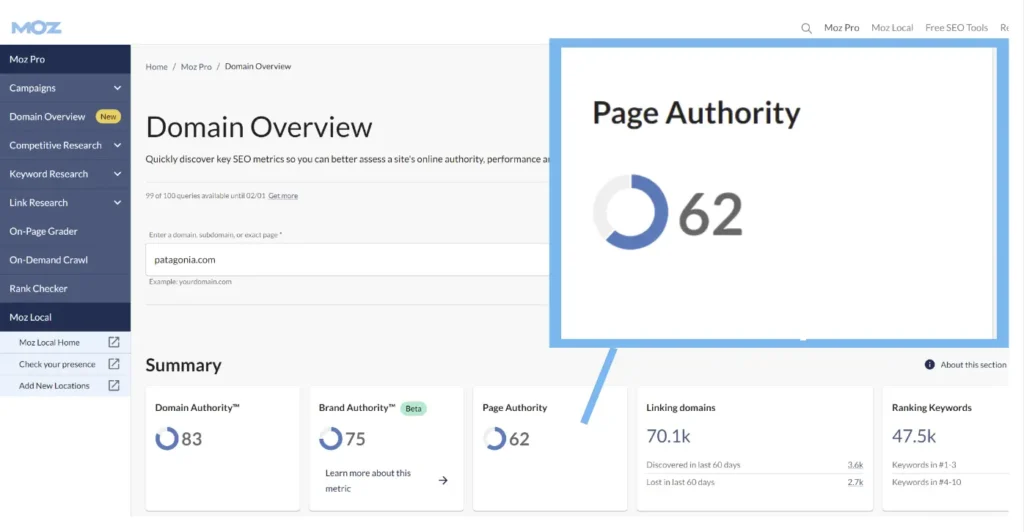
Page Authority is the number most SEO conversations start with — “what’s this page’s PA?” — and the number that most people misuse. It’s a useful instrument when you understand its construction. It’s a trap when you treat it as a ranking guarantee. This guide treats it as what it is: a probabilistic signal model, calibrated against a specific third-party index, that helps you prioritize where to spend link equity.
Defining Page Authority: The Fundamentals
What Page Authority Actually Measures
Page Authority (PA) is a Moz metric, scored 0–100 on a logarithmic scale. It predicts the likelihood that a specific URL will rank well in search results, based on its backlink profile. Moz builds it with a machine-learning model trained against observed ranking data, using signals such as:
- The number of unique linking root domains pointing to the URL
- MozRank (link equity passed through the link graph)
- MozTrust (whether the linking sources sit near trusted seed sites)
- The strength of the linking pages themselves
- The URL’s own position and internal link prominence within its site
So PA isn’t a measurement of a page’s quality, its readability, or its topical fit. It’s an estimate of competitive standing in the link graph. A page with PA 44 has, according to Moz’s model, a moderate chance of ranking for queries where the competing URLs cluster in that band.
The Critical Difference: Page Authority vs. Domain Authority
This is where most teams get sloppy.
| Page Authority (PA) | Domain Authority (DA) | |
|---|---|---|
| Scope | One URL | Entire root domain (aggregate) |
| Predicts | That page’s ranking ability | The site’s overall ranking ability |
| Driven by | Links to that specific URL, plus internal equity | The full backlink profile of the domain |
| Typical use | Prioritizing individual pages, competitor URL comparisons | Vetting link prospects, tracking site-level authority trend |
| Fails when | You use it to judge a whole site | You use it to judge a single page |
A domain can sit at DA 72 while hosting a blog post with PA 18 — the post was published last month and almost nothing links to it. Conversely, a DA 30 site can publish one page that a major industry publication cited, pushing that single URL to PA 48.
Practical rule: if your question is about a page, look at PA. If your question is about a publisher, look at DA. Mixing them produces forecasts that are immediately wrong.
Google’s Stance: PA Is a Proxy, Not a Signal
Google does not use Page Authority. Moz states this plainly, and Google’s spokespeople have confirmed repeatedly that DA and PA are third-party estimates with no direct influence on rankings.
PA is, however, an attempted model of something Google does use: PageRank. Google’s original PageRank concept held that a page’s importance derives from the pages linking to it, weighted by their importance, propagated recursively through the link graph. That concept still describes the shape of Google’s link evaluation, even though the live system is far more sophisticated — evaluating anchor context, topical relevance, link placement, and spam signals that a 0–100 score cannot capture.
The analogy that holds up: PA is a weather forecast, not the weather. It’s derived from the same real system, it’s directionally accurate at scale, and it will occasionally be wrong about your specific page.
The Mathematical and Algorithmic Mechanics Behind PA
Why the Scale Is Logarithmic — and Why Climbing Gets Brutal
Logarithmic means equal score intervals represent equal multiplicative jumps in the underlying link equity. In practice, each +10 points on the PA scale corresponds to roughly an order-of-magnitude increase in the authority required to earn it.
What that means for planning:
- Moving a page from PA 20 → 30 is achievable with a handful of decent editorial links.
- PA 30 → 40 typically requires a dozen or more referring domains, several of them genuinely strong.
- PA 40 → 50 starts demanding links from publishers that are themselves in the 50+ band, on pages that carry real traffic.
- PA 70 → 80 is a multi-year, enterprise-scale link acquisition program.
The distribution of the web is the reason. The overwhelming majority of URLs sit below 30. Very few cross 60. When someone promises to “get you to PA 70 in six months,” they are describing a mathematical impossibility for a new domain, not a strategy.
How Moz Calculates It
Moz’s model is a regression trained on how URLs actually perform, with three core inputs:
- Link counts — raw volume of links and, more importantly, unique linking root domains. Ten links from ten domains beat forty links from one.
- Link equity (MozRank) — a PageRank-style score propagated through Moz’s crawl of the web, so a link from an already-strong page passes more equity than one from an orphaned page.
- Link quality (MozTrust) — a trust-weighted variant seeded from a set of known high-trust sites. Links from near that seed set carry more weight than links from a cluster of interlinked low-trust domains.
Then there’s the index. Moz computes scores against its own crawl of the web, refreshed on a rolling schedule. If Moz hasn’t recrawled a page recently, links to it may not be reflected yet. A newly acquired backlink from a strong page can take weeks to surface in the score. Anyone auditing PA needs to account for that lag before drawing conclusions.
Why PA Fluctuates When You Haven’t Touched Anything
Three causes, in order of frequency:
- Relative scaling. PA is normalized against the distribution of the entire Moz index. If thousands of other URLs gain links and yours doesn’t, your raw authority is unchanged but your position in the distribution slips. The score falls. Nothing happened to your page.
- Index refreshes. Moz drops dead links, devalues spammy link networks, recrawls pages, and re-scores. A link you counted on may be devalued or removed at the source.
- Model updates. Moz periodically retrains the model. Scores shift industry-wide after such updates, which is why DA/PA values from 2019 are not comparable to today’s.
A one- to three-point drift with no change on your end is noise. A sustained ten-point decline across many pages is a signal worth investigating.
Page Authority vs. Competitor URL Metrics
Moz isn’t the only vendor scoring individual URLs. The three you’ll encounter in competitive analysis:
| Metric | Vendor | Scale | What feeds it | Notable bias |
|---|---|---|---|---|
| Page Authority (PA) | Moz | 0–100, logarithmic | Linking root domains, MozRank, MozTrust | Trust-weighted; conservative on new links |
| URL Rating (UR) | Ahrefs | 0–100, logarithmic | Referring domains to that URL, weighted by the DR of each source | Large index; emphasizes raw profile strength |
| Page Authority Score (Page AS) | Semrush | 0–100 | Backlinks, referring domains, and estimated organic traffic | Blends performance, not just links |
The Semrush difference matters. Because Semrush factors organic traffic estimates into Authority Score, a page can post a healthy Page AS while having a thin link profile — it’s ranking, so the score rewards it. That makes Page AS useful for spotting commercially live pages, and less useful for pure link-graph comparison.
When to Use URL-Level Metrics Over Domain-Level Metrics
Use URL-level when:
- Comparing two competing articles for the same query — the domain tells you almost nothing about which page is winning
- Choosing which of your own pages to push links toward
- Evaluating whether a specific page is a realistic target for a link request
- Diagnosing why a page underperforms despite a strong parent domain
Use domain-level when:
- Vetting a site for a link opportunity or guest post
- Tracking overall authority trend over quarters
- Comparing your site against a competitor’s site at a strategic level
Never cross the streams. “Their DA is higher, so we can’t rank” is the single most common analytical error in competitive SEO. Their DA reflects their homepage’s backlink profile. Their ranking page may be weaker than yours.
Actionable Strategies to Increase Page Authority Safely
1. Earn Direct, Contextual Links to the Target URL
Internal equity can lift a page, but the ceiling on a URL’s PA is set by external links pointing at that URL. There’s no substitute.
What actually works:
- Topical relevance over raw domain strength. A link from a moderately authoritative site that covers your exact subject passes more usable equity, and more relevance, than a link from a high-authority general news site with no topical tie.
- Link from pages that carry traffic. A link on a page with real organic sessions sits in a live crawl path and passes equity that a buried page on page nine of a category archive does not.
- Contextual, in-body placements. Links inside body copy, surrounded by relevant text, beat footer mentions, author bios, and resource-list entries.
- Digital PR assets. Original data, benchmarks, tooling, and definitive explainers attract links without outreach. One genuinely useful dataset outperforms fifty templated guest post pitches.
Avoid: paid link networks, PBNs, reciprocal link schemes at scale, and automated outreach blasts. These produce short-term score movement followed by devaluation when the vendor’s spam model catches up.
2. Internal Linking: Move Equity Deliberately
Internal links are the one lever you control entirely. Google treats them as editorial votes within your own site, and Moz’s model does the same.
A workable process:
- Pull your top 10 pages by external referring domains. These are your equity sources.
- Identify 15–25 target URLs — commercial pages, pillar guides, money pages — that need a boost.
- Add contextual, descriptive in-body links from the sources to the targets, using anchor text that describes the destination rather than repeating an exact-match keyword.
- Keep link depth shallow. Any page you care about should be reachable within three clicks of the homepage.
The compounding effect here is real: internal links raise the target’s MozRank input, which shows up in PA, and simultaneously improve crawl frequency and topical clustering signals.
3. Eliminate Internal Link Dilution
Every link on a page splits the equity that page can pass. Most sites leak it carelessly.
Audit these four:
- Orphan pages — URLs with no internal links pointing to them, discoverable only via sitemap. Either link them properly or consolidate them. Sites with large orphan populations spread authority across pages that can never rank.
- Redirect chains — each hop (A → B → C → D) is a documented equity-loss path and a crawl-budget drain. Collapse every chain to a single 301 pointing directly at the final destination.
- Low-value outbound links — excessive links to social profiles, tag archives, thin category pages, and unrelated partner sites. These aren’t toxic, but they dilute. Prune aggressively and consider
nofollowon anything that isn’t editorially warranted. - Duplicate near-URLs — paginated archives, tracking-parameter variants, and print versions that split inbound equity across multiple addresses. Canonicalize.
A site that fixes its internal link architecture often sees PA movement across dozens of pages without acquiring a single new backlink.
4. Deepen Content to Attract Recurring Citations
Links are earned by pages that other people need to reference. Depth is what makes a page citable rather than merely readable.
- Add proprietary data — survey results, internal benchmarks, original screenshots of live tests.
- Build the definitive resource on a narrow question rather than a shallow overview of a broad one.
- Update on a visible cadence and mark it (last-updated date, changelog). Editors link to pages they believe will stay accurate.
- Include assets people embed: tables, checklists, comparison matrices, calculators.
Recurring citation is the only link source that compounds without ongoing outreach cost.
Common Myths and Misconceptions
Myth 1: “High PA guarantees a #1 ranking.”
PA is a correlation-based estimate. Pages rank because of relevance, intent match, content quality, technical health, and link signals together — plus whatever the SERP features crowd out. A PA 62 page will lose to a PA 35 page that answers the query better, every time. PA is a probability input, not a rank.
Myth 2: “On-page SEO directly increases PA.”
It doesn’t. Title tags, header structure, schema markup, and keyword placement are invisible to the PA model, which reads the link graph. On-page work raises PA only indirectly — better content earns links, and internal linking structure changes how equity flows.
Worth adding: on-page work still wins rankings. It just doesn’t move this particular score, and expecting it to will send you chasing the wrong metric.
Myth 3: “A low-PA page can never outrank a high-PA page.”
Routinely contradicted. Long-tail queries are frequently won by pages in the teens and twenties because the high-PA competitors don’t actually address the specific intent. The corollary matters more for strategy: for broad, competitive head terms, link authority becomes a hard gate — you generally cannot win without it.
Practical Audit Workflow: Finding “Striking Distance” Pages
The highest-ROI use of PA is triage. Pages ranking positions 4–15 already have enough relevance and technical footing to compete; they’re typically one authority nudge away from the top three. Here’s the four-step version.
Step 1 — Pull the striking-distance set. Export your queries ranking in positions 4–15 from Search Console (or Semrush/Ahrefs). Filter to queries with meaningful impressions and commercial intent. You’ll usually land on 10–40 URLs.
Step 2 — Attach PA to both sides. For each target URL, record its PA. Then pull the median PA of the URLs currently ranking in positions 1–3 for the same query. The gap tells you what you’re up against:
- Gap ≤ 5 points → likely solvable with internal links and content refresh
- Gap 6–15 points → needs 3–8 quality editorial links
- Gap > 15 points → content-led digital PR campaign, or deprioritize
Step 3 — Apply the cheap fix first. Before outreach, add three to six contextual internal links from your highest-equity pages to each target, fix any redirect chains in the path, and refresh the content with new data. Recheck PA after the next index refresh — often the gap closes enough that outreach becomes unnecessary.
Step 4 — Prioritize outreach by gap-to-effort ratio. Sort the remaining targets by (ranking potential ÷ PA gap). Send outreach only for pages where a realistic link acquisition gets you inside the top-three PA band. Pages needing a 20-point jump go in the backlog, not the campaign.
Run this quarterly. Sites that treat it as a standing process — the kind of operational cadence written about at length on linksbuilderhub.com — consistently outperform teams that chase DA headlines instead of page-level gaps.
Executive Summary
Page Authority is a 0–100 logarithmic estimate of a single URL’s ability to rank, built by Moz from link counts, propagated equity (MozRank), and trust-weighted link quality (MozTrust), calibrated against Moz’s own crawled index. It is not a Google signal. It models PageRank’s underlying logic without access to Google’s actual data.
Use it as a compass, not a destination:
- It tells you which pages are underpowered relative to their competition — that’s its real job.
- It tells you where a handful of links or internal equity moves will pay off fastest — the striking-distance workflow.
- It does not tell you whether your content satisfies intent, and it will never override a relevance mismatch.
The teams that get value from PA are the ones that check it quarterly, compare it against the top-three band for specific queries, and then close the gap with deliberate link placement. The teams that chase the number itself spend years acquiring links for pages that were never going to convert, and wonder why the score went up while revenue didn’t.
Score the page, then go earn the reasons the score should be higher.