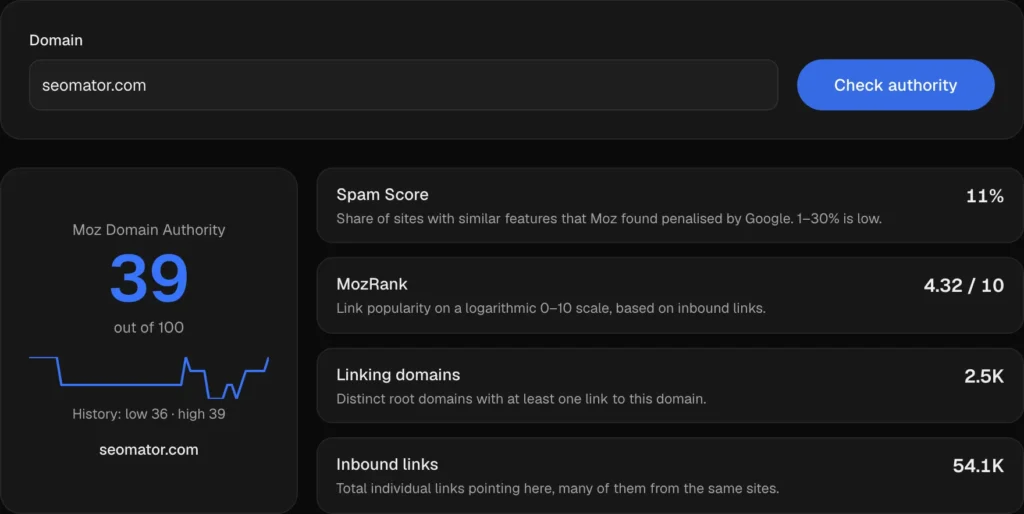
Ask ten SEOs what a site’s DA is and most will answer without hesitation. Ask them what that number actually measures, and the room gets quieter. Domain Authority belongs to Moz. Domain Rating belongs to Ahrefs. Google owns neither, reads neither, and has said so more than once. These are third-party estimates — educated guesses about how strong a backlink profile looks, built from each company’s own crawl data.
So why bother checking at all? Because a domain authority checker still tells you something useful, as long as you know what you’re reading. It won’t reveal how Google ranks your pages. It will show how one tool’s model interprets your link footprint — and that’s a decent proxy when you’re comparing yourself to competitors, filtering sketchy link prospects, or deciding whether a partnership is worth your time.
Here’s the working breakdown I’d give a junior strategist on day one: how the scores get calculated, which free tools are worth trusting, and how to grow authority without gaming a number that Google ignores anyway.
How Domain Authority Metrics Are Actually Calculated
Every checker runs its own formula, but they all chew on roughly the same raw material. Understand those inputs and you’ll stop treating the score like a grade from teacher.
Referring Domains vs. Total Links
Picture two sites. Site A has 5,000 backlinks from 20 domains. Site B has 500 backlinks from 300 domains. Site A looks bigger on a dashboard and loses every time in practice.
Authority algorithms lean hard on unique referring domains, because 300 different editors choosing to cite you is far harder to fake than 5,000 links from one network. This is exactly why buying fifty links from a single PBN barely nudges the meter. The tools were built by people who anticipated that trick.
Link Equity: Dofollow vs. Nofollow Ratios
Nofollow, UGC, and sponsored attributes tell crawlers not to pass ranking equity along. Authority checkers still see those links and count them for context, but their contribution to the actual score is thin — sometimes close to nothing. A profile stuffed with forum signatures, blog comments, and social shares will show an impressive “total backlinks” figure next to a disappointingly flat authority score. The dofollow editorial links are what move it.
Root Domain Diversity and Link Velocity
Two more variables separate organic growth from manufactured growth:
- Root domain diversity — links from news outlets, niche blogs, resource pages, and different TLDs read as natural. Links clustered inside one PBN or one country-code farm read as purchased.
- Link velocity — how fast new referring domains appear. Two hundred new domains in a week is the fingerprint of a link package. Genuine growth tends to trickle in around content launches and PR moments.
The Risk of Metric Manipulation
A site sitting at DA 45 with 200 monthly organic visitors is a warning sign, not a bargain. That gap usually means links came from PBNs, link farms, or recycled expired domains — tactics built to impress checkers, not readers. I’ve watched affiliates pay for guest posts on exactly these sites and wonder why nothing moved afterward.
This is why serious link buyers never approve a placement on authority alone. Teams working through linksbuilderhub.com cross-check every prospect’s authority score against verified monthly organic traffic before signing off — a DA 40 site with no real audience loses to a DA 20 site pulling 5,000 visitors a month, every single time.
Best Free Domain Authority Checkers Worth Your Time
Free tiers differ wildly, and so do the metrics behind them. Here’s how the main options stack up in practice.
Moz Free Domain Analysis
Moz invented the metric, scored 1–100 on a logarithmic curve. The free tool also throws in Spam Score, a useful flag for toxic link patterns, plus a peek at top linking domains. Lookups are capped per day without an account. Technically, Moz’s index isn’t the largest — but DA remains the number clients recognize, and that alone keeps it relevant for reporting.
Best for: quick client-facing benchmarks and spam screening.
Ahrefs Website Authority Checker
Ahrefs reports Domain Rating (DR) on a 0–100 scale, built from referring domain strength. The free checker shows backlink counts and a trimmed referring domains list; full gap analysis and historical data need a paid plan. Ahrefs refreshes its index aggressively, which makes DR a sharper read on real link equity than most alternatives.
Best for: link gap analysis and competitor backlink research.
Semrush Domain Overview
Semrush’s Authority Score blends backlink data with organic visibility and traffic estimates — less pure-link math, more of a whole-site picture. The free Domain Overview shows keyword counts, estimated traffic, and top backlinks without a subscription, though the deeper reports sit behind a paywall.
Best for: reading authority and traffic together in one screen.
SmallSEOTools and Free Web Scrapers
These tools don’t crawl anything themselves. They scrape Moz or a third-party API and display the result. Handy for a one-off lookup, unreliable for anything that matters — figures go stale, rate limits kick in, and values sometimes disagree with the source tool altogether. Never send a client a screenshot from one of these.
Best for: casual checks, nothing client-facing.
Why Traffic Beats the Score Every Time
Authority scores answer one question: does this backlink profile look strong? They say nothing about whether real people visit. That gap is where experienced buyers split from beginners. Run every prospect through both an authority checker and a traffic estimate — Semrush and Ahrefs both handle that in seconds — and you’ll filter out most of the junk before it costs you money.
Step-by-Step: How to Check and Audit Your Domain Authority
Step 1: Run the Baseline Check
Use at least two tools — Moz for DA, then Ahrefs or Semrush for DR and Authority Score. Note the numbers next to your referring domain count and total backlinks. One snapshot tells you nothing; log it with the date so the next audit has something to compare against.
Step 2: Evaluate Spam Score and Toxic Inbound Links
Pull your Spam Score, then cross-reference flagged domains against Ahrefs or Semrush toxic link reports. Watch for:
- Links from unrelated foreign-language sites with zero topical tie to you.
- Sudden clusters from low-quality directories or PBN-style blogs.
- Exact-match anchor text from domains with no organic traffic of their own.
Toxic links rarely tank rankings on their own, but they muddy your score and can raise flags when the pattern gets extreme. Only disavow after confirming a link is genuinely harmful — low authority alone isn’t a reason.
Step 3: Benchmark Against Direct Organic Competitors
Pick 3–5 competitors who actually outrank you for your target keywords. Not the brands you admire — the ones sitting above you in the SERPs. Run the same checks on them. If they hold three times your referring domains, your content may be fine and your link profile is the bottleneck.
Step 4: Find the Link Acquisition Gaps
Ahrefs Link Intersect and Semrush Backlink Gap both surface domains linking to several competitors but not to you. Those are your warmest outreach targets — the editors already link to sites like yours, so the pitch writes itself.
Domain Authority Checker Comparison Table
| Tool Name | Metric Used | Scale | Free Limit | Best For |
|---|---|---|---|---|
| Moz | Domain Authority (DA) + Spam Score | 1–100 | ~10 lookups/day with account | Fast benchmarking, spam screening |
| Ahrefs | Domain Rating (DR) | 0–100 | Limited backlinks per lookup | Link gap and competitor analysis |
| Semrush | Authority Score | 0–100 | Limited free reports/day | Authority plus traffic in one view |
| SmallSEOTools | Scraped DA/DR | 1–100 | Uncapped but rate-limited | Casual one-off checks only |
Actionable Next Steps: How to Legally Increase Your Domain Authority
Earn High-Tier Editorial Backlinks Through Manual Outreach
Real authority comes from links editors hand you because your page earned it. Manual outreach to relevant publishers and niche bloggers still delivers the best return, as long as you vet targets on traffic and topical fit rather than DA alone. Personalized pitches, genuine relevance, strict publisher screening — that’s the white-hat method linksbuilderhub.com applies when running editorial campaigns, and it’s why volume-obsessed link packages rarely survive a second algorithm update.
Fix Internal Link Leakage and Broken 404s
Crawl the site with Screaming Frog or Ahrefs Site Audit and look for:
- Orphan pages with no internal links pointed at them.
- Broken internal links passing zero equity.
- 404s that once held backlinks — 301 them to relevant live URLs to reclaim that equity.
Internal linking won’t create new authority, but it spreads what you already have. Underlinked pages often climb within a few weeks of a cleanup.
Publish Original Data and Linkable Assets
Benchmark studies, surveys, and free tools collect citations long after publication. One well-promoted data study can pull in dozens of unprompted referring domains over a year — compounding growth with no outreach invoice attached.
Frequently Asked Questions
Is Domain Authority an official Google ranking factor?
No. Google has confirmed repeatedly that it doesn’t use Moz’s DA, Ahrefs’ DR, or Semrush’s Authority Score. They’re third-party estimates meant to help marketers benchmark backlink strength — nothing more.
What is considered a good Domain Authority score for a new website?
For a site under a year old, DA 10–20 is normal and healthy. The scale is logarithmic, so going from 20 to 30 demands far more link equity than 0 to 10. Judge yourself against niche competitors, not some universal target.
Why does my Domain Authority drop?
Usually one of three things: high-authority referring domains disappeared, the tool recalculated its index, or low-quality links diluted the overall profile. Check organic traffic and keyword positions before panicking — a score dip doesn’t always mean lost rankings.
How often do authority checkers update their scores?
Moz refreshes DA roughly every 2–4 weeks with each index update. Ahrefs recalculates DR continuously as its crawler revisits the web, often within days. Semrush follows a similar rolling schedule. None of them update in real time, so don’t expect a same-day jump after a link goes live.
Conclusion
A domain authority checker is a diagnostic tool, not a trophy. Use it to benchmark competitors, screen link prospects, and track direction — then put it down. Rankings follow verified organic traffic, contextually relevant editorial links, and site architecture that moves equity where it’s needed. Chase topical relevance and genuine citations, and the score will follow on its own. Chase the score directly, and you’ll end up buying links from sites nobody reads.